
Articles from the month of August!
Feast of St. Augustine & Monica
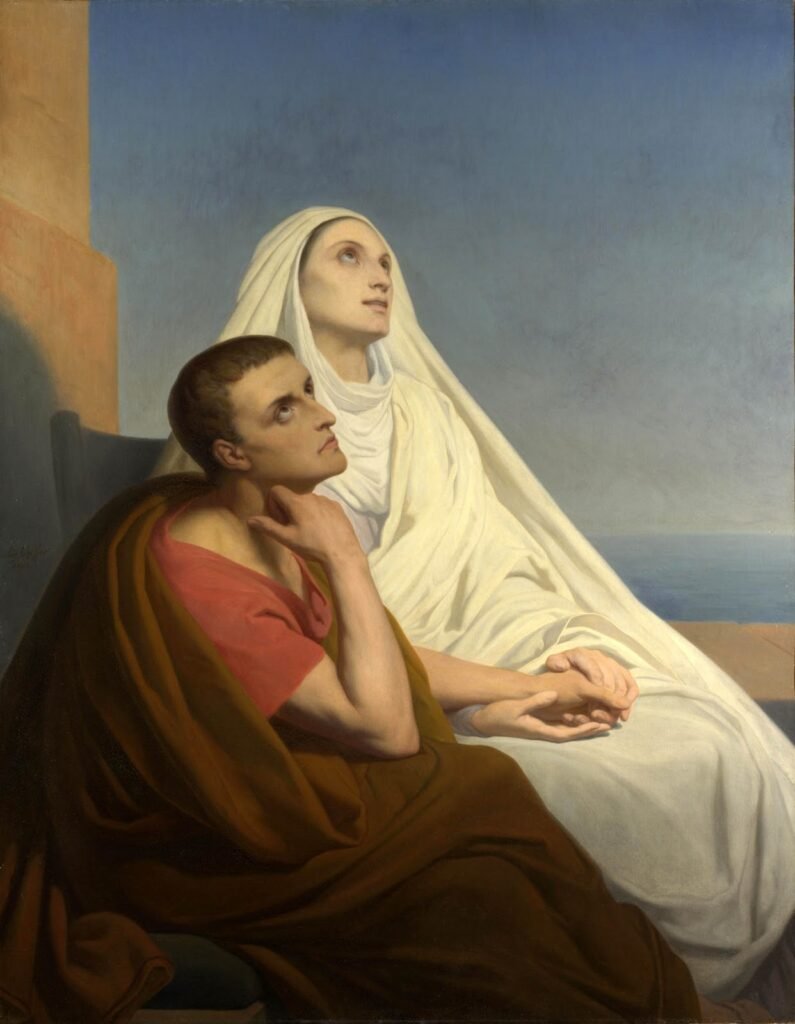
Every 27th and 28th of August, the whole Augustinian Family commemorates two significant figures of the Augustinian Order, St. Monica and St. Augustine, the spiritual father and inspiration of Augustinians worldwide. In union with this tradition, the Asia-Pacific Augustinian Novices, together with the Novitiate and Prayer House community, celebrated these days in a spirit of simplicity, joy, and thanksgiving to God for another year of grace and hope.
The feast of St. Monica on August 27 began with Lauds, followed by the Holy Mass presided over by Rev. Fr. Bong Messina, OSA, House Prior. In his homily, he invited the community to embody the virtues of St. Monica; her firm love, dedication, and perseverance in prayer. At midday, the Novices joined the neighboring Augustinian communities for a fraternal lunch at the Aula Magna in the Santo Niño Pilgrim Center, where joy, gratitude, and fellowship were shared in honor of the beloved mother of St. Augustine.
The following day, August 28, the Solemnity of Our Holy Father Augustine opened with Lauds, as hymns and psalms were sung in thanksgiving to God and in praise of the saint who continues to inspire a life of truth, unity, and love. In the afternoon, the community, together with the workers, gathered for a lively boodle fight, sharing simple Filipino delicacies in one table, strengthening friendship and joy in each other’s presence.
The celebration concluded in the evening with a solemn Mass at the Basilica Minore del Sto. Niño de Cebu, presided over by Most Rev. Jose S. Palma O. P., the Apostolic Administrator of the Archdiocese of Cebu. This two-day celebration not only honored the legacy left by the two great Augustinian saints, St. Monica and St. Augustine, but also a renewal of each commitment to live out their example of prayer, perseverance, unity, and love in daily life.
Hope as an Existential Act
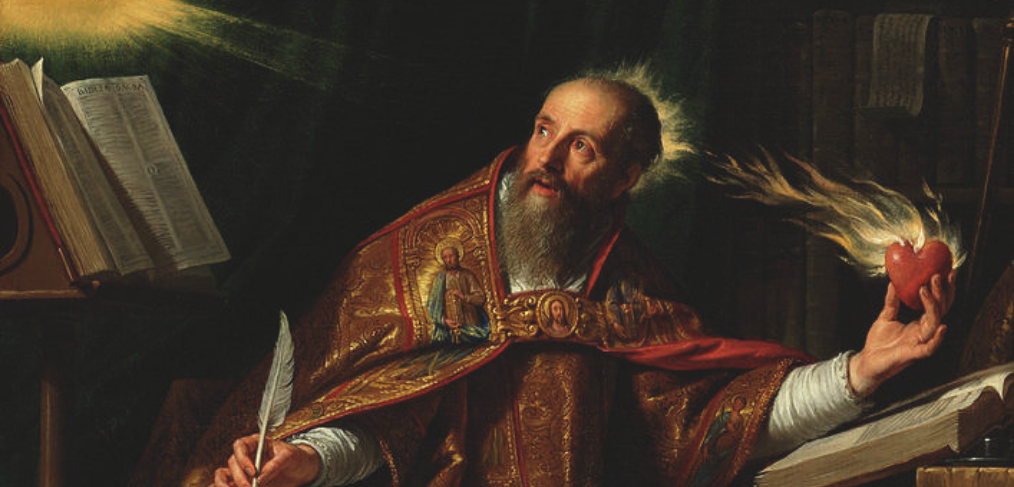
An Augustinian Reflection
When we open the pages of Saint Augustine’s Confessions, we find not only the story of one man’s conversion, but also a mirror of our own struggles. Augustine does not speak to us from a distant pedestal; he speaks as a brother who wrestled with weakness, desire, and fear. Yet through all these struggles, he discovered the transforming power of hope—hope as a living act, an existential movement of the soul toward God.
Hope and Human Freedom
Augustine reminds us that hope is not passive waiting, but an act of freedom. God has placed within us the capacity to choose: between good and evil, between despair and hope. Hope, then, is not something that simply happens to us; it is something we choose, a deliberate turning toward God. Augustine writes:
“Is not happiness what all desire? And is there anyone who does not long for it? … Some are happy by possessing it, others only in hope. These have a lesser happiness than those who already possess it, but a greater happiness than those who neither possess it nor hope for it.” (Conf. X,20,29).
Like Augustine, we often know what is good and yet hesitate to embrace it. He himself admits:
“I loved the beauty of chastity, but I feared that You might hear me too quickly and cure me at once of the disease of lust, which I preferred to be satisfied rather than extinguished.” (Conf. VIII,7,17).
These words reveal a truth we all recognize: it is easier to cling to old habits than to step into God’s newness. Hope, however, calls us to a deeper freedom—to trust that what God offers is not loss, but fullness of life.
Hope in Times of Trial
Augustine also teaches that hope is not an escape from suffering. On the contrary, it is often in moments of loss and trial that hope shines most clearly. He recalls with tears the death of his beloved mother, Monica. Yet even in grief, hope became his anchor:
“I did not weep like those without hope. For I knew that the soul of the just does not perish. She had not died for me, but only departed from this body to live with You.” (Conf. IX,12,29).
Here Augustine shows us that hope does not remove sorrow but purifies it. Hope allows us to mourn without despair, to trust that every separation is temporary, and that our final communion is with God.
We, too, as brothers on this Augustinian path, encounter trials—personal weakness, misunderstandings, the burden of community life, or the limits of age and health. Yet in each of these, hope is not absent. It is in the very darkness that hope is tested and made strong. As Augustine prayed:
“O Lord, my hope from my youth—where were You then, and how far did You withdraw Yourself from me? … I sought You outside myself, and I fell into the depths of despair.” (Conf. VI,1,1).
Even in such cries, hope is alive. It becomes a prayer, a longing, a reaching out to the One who is always closer than we imagine.
A Daily Ascent Toward God
Brothers, for Augustine, hope is never static. It is a daily act of the will, a step forward in freedom, a leaning toward God in both joy and trial. It is purified by suffering, strengthened by perseverance, and made complete in love.
Ultimately, hope is not only about the future; it is about today. It is the decision to rise once more, to choose God again, to let our hearts burn with His presence. Augustine testifies:
“You touched me, and I burned for Your peace.” (Conf. X,27,38).
This burning is our vocation, too. Each day, in prayer, in fraternity, in service, we are invited to live hope as an existential act—an act that says: “My life is in God’s hands, and in Him alone will I find my rest.”
May this Augustinian hope sustain us on the journey, and may we encourage one another, as brothers, to keep choosing the path of hope, until we find our eternal rest in God.
Building the Body of Christ in Our Time
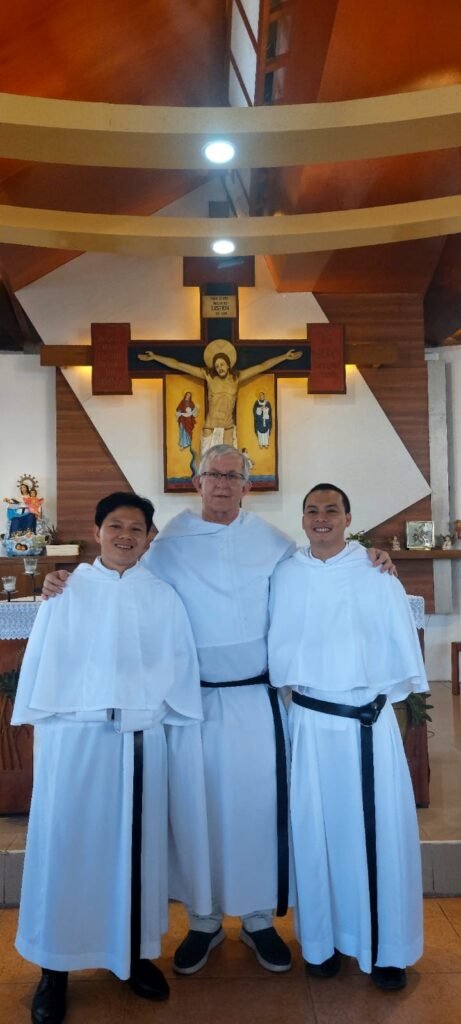
“We Are the Body of Christ”
An Augustinian Meditation Inspired by Fr. Tony Banks, OSA
When Fr. Tony Banks, OSA, Assistant General of the Order, spoke to us on the theme “We are the Body of Christ” (1 Cor 12:27), he did not simply offer a theological discourse. His words were more like an Augustinian meditation: drawing us inward, awakening us to Christ’s presence in our midst, and challenging us to live more deeply as brothers united in one Body.
1. Christ Dwelling in the Midst of His People
The starting point of Fr. Tony’s reflection was the mystery of the Incarnation: “The Word became flesh and dwelt among us” (Jn 1:14). Christ does not remain at a distance; He chooses to dwell here, in the midst of our frailty. This is not an abstract truth. It is the living foundation of our identity as Church, and in a particular way, as Augustinians called to community.
St. Augustine experienced this mystery firsthand. After years of searching outside himself, he came to realize that God had been nearer than he ever imagined:
“You were within me, but I was outside, and it was there that I searched for You.” (Conf. X,27,38).
Like Augustine, we too often look outside — to success, recognition, or comfort — for what only Christ’s presence can give. Yet the Body of Christ is built not in grand achievements, but in the humble recognition that God dwells within us and among us as brothers.
2. The Restlessness and Perseverance of Prayer
Fr. Tony reminded us that prayer is central to our Augustinian life. But he also noted that prayer is not always consoling. At times it feels dry, empty, even frustrating. Yet Augustine teaches us that this restlessness is itself a path toward God:
“You have made us for Yourself, O Lord, and our hearts are restless until they rest in You.” (Conf. I,1).
To persevere in prayer despite darkness is an act of fidelity to Christ. St. Teresa of Calcutta endured years of interior darkness and yet never ceased to serve and pray. Augustine too, restless and searching, discovered that God was guiding him even in his wandering. In our communities, perseverance in prayer — even when we do not feel its sweetness — is a way of allowing the Body of Christ to grow stronger among us.
3. Confession, Conversion, and the Gift of Time
Another theme Fr. Tony developed was the role of confession and time in our spiritual journey. Augustine’s meditation on time in Confessions remains one of the most profound in Christian thought:
“What then is time? If no one asks me, I know; if I wish to explain it to one who asks, I do not know.” (Conf. XI,14,17).
Time is fragile, passing, and often beyond our grasp. But it is precisely within time that eternity touches us. The Sacrament of Reconciliation allows us to encounter that touch of eternity: God breaks into our history, transforms our sins, and makes of our fragile time a place of new beginnings.
Augustine experienced this deeply:
“You turned my mourning into rejoicing, and You girded me with gladness.” (Conf. IX,1,1).
For us, confession is not merely an obligation; it is a continual renewal of our identity as members of Christ’s Body. It allows us to “preach first to ourselves,” as Fr. Tony reminded us, so that our lives themselves may become preaching for others.
4. Human Dignity and the Light of the Trinity
Fr. Tony also touched on the value of the human person, created in the image of God. Augustine’s testimony reveals the depth of this mystery:
“Late have I loved You, O Beauty ever ancient, ever new! You were within me, and I was outside.” (Conf. X,27,38).
To be human is to be oriented toward God. Outside of Him, we lose ourselves. Within Him, we discover our true dignity. This vision is not abstract: it challenges us to respond to pressing social issues, such as the defense of life, with courage and compassion. The Body of Christ suffers wherever life is denied. It is our Augustinian mission to witness to the sacredness of life and the dignity of every person.
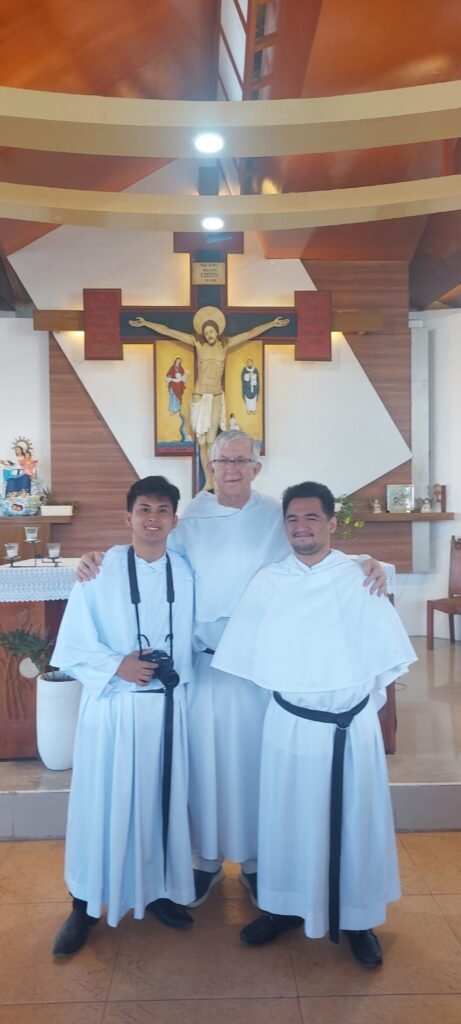
5. The Two Loves and the Two Cities
Fr. Tony concluded by recalling Augustine’s vision of the City of Man and the City of God. These are not simply historical categories, but spiritual realities alive in every human heart. Augustine summarizes them with striking clarity:
“Two loves have made two cities: the love of self, even to the contempt of God; and the love of God, even to the contempt of self.” (City of God XIV,28).
As Augustinians, we live in the tension of these two cities every day. The question is: which love will shape our choices? Community life, prayer, reconciliation, and service are all ways of choosing the City of God — of letting the love of God conquer the love of self.
Conclusion: Burning for Peace
Fr. Tony’s reflection reminded us that our Augustinian vocation is not a matter of theory but of lived love. To be the Body of Christ is to let His presence dwell in us, to persevere in restless prayer, to seek reconciliation as renewal, and to commit ourselves to building the City of God.
In the end, the words of Augustine become our own prayer:
“You touched me, and I burned for Your peace.” (Conf. X,27,38).
May this burning for peace unite us more deeply as brothers, and may it inflame our communities and ministries with the living presence of Christ.
The Power & Freedom of Surrender
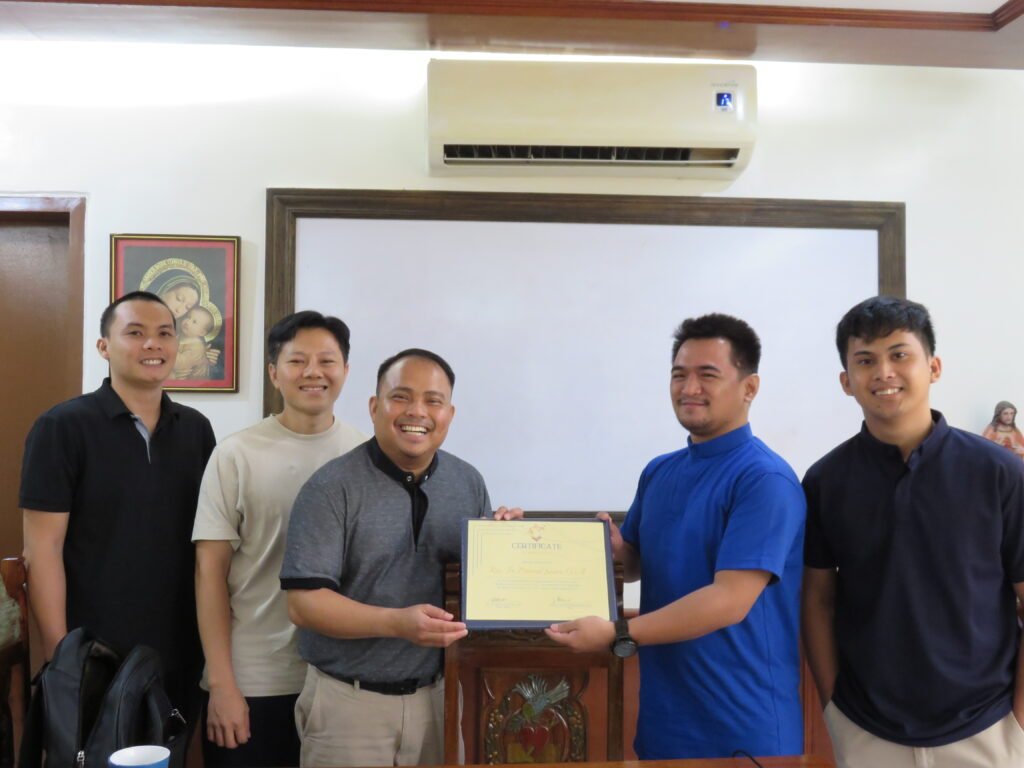
Already excited for the events awaiting them in August, the novices were first given a brief moment of respite to reflect on the upcoming activities. On August 12, 2025, the novices attended another recollection, this time with Rev. Fr. Percival Sevare, whose theme was “The Power and Freedom of Surrender.”
At first, the theme of surrender seemed daunting to the novices, often associated with “defeat” or “weakness” and the loss of control. However, Fr. Percival helped the novices broaden their understanding of surrender and its vital role in spiritual life.
In the midst of life’s busyness and the trials that come with it, we are often overwhelmed by chaos and feel the need to seize control to regain some sense of power. It is rare that we have the opportunity to fully and completely surrender everything to God. Fr. Percival explained that surrender is not a passive act, but an active form of trust in the Lord. It is choosing to believe that God is with us and for us, even when things don’t make sense. It is trusting that all of life is in the loving hands of God.
Even when circumstances seem bleak, surrender is about finding hope and strength, knowing that, no matter how dark or frightening our situation may seem, God is right there with us, providing a path of comfort and strength to help us navigate through any challenge.
Surrendering is not an easy task, as it requires letting go of the need for control and surrendering fully as a person. It asks of us attentive listening, a contemplative attitude, trust, and grace. And by practicing these qualities and trusting in God, we stand to gain everything.
“Give me the grace to do as You command, and command me to do what You will.”